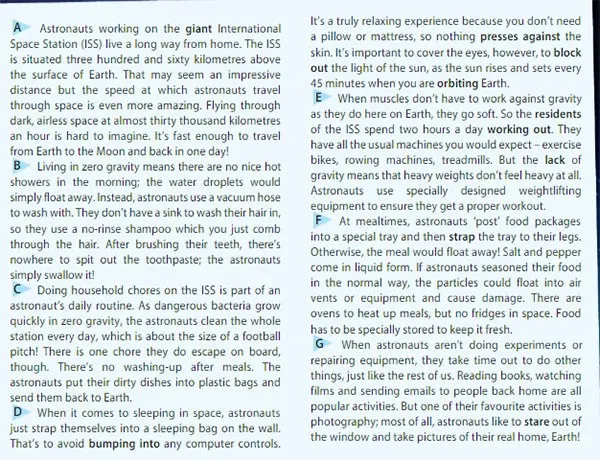
A) Astronauts working on the giant International Space Station (ISS) live a long way from home. The ISS is situated three hundred and sixty kilometres above the surface of Earth. That may seem an impressive distance but the speed at which astronauts travel through space is even more amazing. Flying through dark, airless space at almost thirty thousand kilometres an hour is hard to imagine. It’s fast enough to travel from Earth to the Moon and back in one day!
А) Космонавты на огромной Международной космической станции (МКС) живут очень далеко от дома. Станция находится в 360 км над поверхностью Земли. Расстояние кажется внушительным, но скорость, с которой они движутся, ещё поразительнее. Трудно представить полёт в тёмной безвоздушной пустоте со скоростью почти 30 000 км/ч. С такой скоростью можно за один день долететь от Земли до Луны и вернуться обратно!
B) Living in zero gravity means there are no nice hot showers in the morning; the water droplets would simply float away. Instead, astronauts use a vacuum hose to wash with. They don’t have a sink to wash their hair in, so they use a no-rinse shampoo which you just comb through the hair. After brushing their teeth, there’s nowhere to spit out the toothpaste; the astronauts simply swallow it!
В) В невесомости не бывает приятного горячего душа по утрам: капли воды просто разлетелись бы. Поэтому космонавты моются с помощью вакуумного шланга. Раковины для мытья головы нет, и они пользуются шампунем, который не нужно смывать, его просто вычёсывают из волос. После чистки зубов плюнуть некуда, так что зубную пасту просто глотают!
C) Doing household chores on the ISS is part of an astronaut’s daily routine. As dangerous bacteria grow quickly in zero gravity, the astronauts clean the whole station every day, which is about the size of a football pitch! There is one chore they do escape on board, though. There’s no washing-up after meals. The astronauts put their dirty dishes into plastic bags and send them back to Earth.
С) Домашние дела на МКС входят в ежедневный распорядок космонавта. Опасные бактерии в невесомости быстро размножаются, поэтому всю станцию, а она размером с футбольное поле, убирают каждый день! Правда, от одной работы космонавты избавлены: посуду после еды они не моют. Грязные тарелки кладут в пластиковые пакеты и отправляют на Землю.
D) When it comes to sleeping in space, astronauts just strap themselves into a sleeping bag on the wall. That’s to avoid bumping into any computer controls. It’s a truly relaxing experience because you don’t need a pillow or mattress, so nothing presses against the skin. It’s important to cover the eyes, however, to block out the light of the sun, as the sun rises and sets every 45 minutes when you are orbiting Earth.
D) Чтобы поспать в космосе, космонавты привязываются к спальному мешку на стене. Так они не наткнутся на компьютерные панели управления. Такой сон по-настоящему расслабляет: подушка и матрас не нужны, поэтому ничто не давит на тело. Но глаза нужно закрывать повязкой, чтобы не мешал солнечный свет, ведь при полёте вокруг Земли солнце встаёт и садится каждые 45 минут.
E) When muscles don’t have to work against gravity as they do here on Earth, they go soft. So the residents of the ISS spend two hours a day working out. They have all the usual machines you would expect – exercise bikes, rowing machines, treadmills. But the lack of gravity means that heavyweights don’t feel heavy at all. Astronauts use specially designed weightlifting equipment to ensure they get a proper workout.
Е) Здесь, на Земле, мышцы работают против силы тяжести, а когда этого нет, они становятся вялыми. Поэтому жители МКС тренируются по два часа в день. Там есть привычные тренажёры: велотренажёры, гребные тренажёры, беговые дорожки. Но из-за отсутствия гравитации тяжести совсем не кажутся тяжёлыми, поэтому космонавты занимаются на специально сконструированных силовых тренажёрах, чтобы получить настоящую нагрузку.
F) At mealtimes, astronauts ‘post’ food packages into a special tray and then strap the tray to their legs. Otherwise, the meal would float away! Salt and pepper come in liquid form. If astronauts seasoned their food in the normal way, the particles could float into air vents or equipment and cause damage. There are ovens to heat up meals, but no fridges in space. Food has to be specially stored to keep it fresh.
F) Во время еды космонавты «отправляют» пакеты с продуктами в особый лоток и пристёгивают его к ногам. Иначе еда улетела бы! Соль и перец там жидкие. Если бы космонавты солили еду как обычно, частицы могли бы залететь в вентиляцию или технику и испортить её. Для разогрева еды есть печи, а вот холодильников в космосе нет, поэтому продукты нужно особым образом хранить, чтобы они не портились.
G) When astronauts aren’t doing experiments or repairing equipment, they take time out to do other things, just like the rest of us. Reading books, watching films and sending emails to people back home are all popular activities. But one of their favourite activities is photography; most of all, astronauts like to stare out of the window and take pictures of their real home, Earth!
G) Когда космонавты не ставят опыты и не чинят оборудование, они, как и все мы, находят время для отдыха. Они читают, смотрят фильмы и пишут письма домой по электронной почте. Но больше всего им нравится фотографировать: они часами смотрят в иллюминатор и снимают свой настоящий дом — Землю!