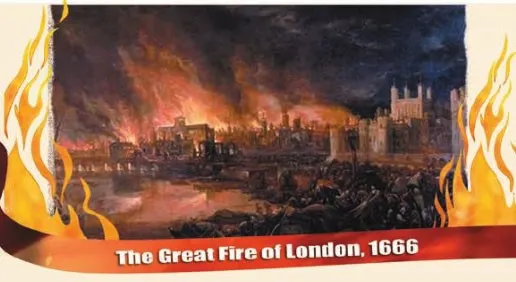
«In sixteen hundred and sixty-six,
Old London burned like rotten sticks.»
In 1666, London was a city just waiting to burn. Narrow streets were overcrowded with buildings. Open fires and candles burned inside homes and businesses. A long, hot summer had just 1) come to an end, and the wood-built city was bone dry. On the evening of Saturday, 1st September, Thomas Farynor, baker to King Charles II, went to bed without properly putting out the fire in one of his ovens. Sometime after 1:00 am on Sunday morning, a spark from the fire’s embers ignited some straw on the bakery floor. Flames quickly engulfed the house in Pudding Lane. Neighbours attempted to put out the fire, but the flames were 2) too fierce. The fire began to spread.
At 4:00 am, London’s mayor, Sir Thomas Bloodworth, was woken up. He was advised to have all the neighbouring houses demolished, as this would stop the fire spreading, but the Mayor refused to give the order. He paid 3) dearly for this decision. By early morning, three hundred houses were on fire and winds from the east were causing the fire to spread with frightening speed.
4) Over the next three days and nights, the fire raged out of control. It took until the evening of Wednesday, 5th September, when the 5) strong winds finally died down, to bring the fire under control.
When the fire was totally extinguished on Thursday, 6th September, five-sixths of the heart of the city had been destroyed. Over 13,000 houses, 87 churches and 4 bridges, 6) along with many important buildings, such as St Paul’s Cathedral, were gone. Astonishingly, however, it is thought that fewer than ten people died in the blaze!
If you visit London today, you can see a tall column — called The Monument — commemorating the Great Fire. It stands at 202 feet tall — the distance from its location to the site of Thomas Farynor’s bakery — so if it fell over in the right direction, it would 7) point to the exact spot where the fire started!
«В тысяча шестьсот шестьдесят шестом старый Лондон вспыхнул, как гнилые щепки».
В 1666 году Лондон был готов вспыхнуть в любую минуту. Узкие улочки были забиты тесно стоящими домами. В жилищах и мастерских горели открытые очаги и свечи. Долгое знойное лето только что закончилось, и деревянный город высох до предела. Вечером в субботу, 1 сентября, Томас Фэринор, пекарь короля Карла II, лёг спать, не загасив как следует огонь в одной из печей. Немного позже часа ночи в воскресенье искра от тлеющих углей зажгла солому на полу пекарни. Огонь быстро захватил дом на Пудинг-лейн. Соседи пытались его погасить, но пламя оказалось слишком сильным. Пожар стал разрастаться.
В четыре утра разбудили лондонского мэра сэра Томаса Бладворта. Ему посоветовали разрушить все соседние дома, чтобы огонь не пошёл дальше, но мэр не стал отдавать такой приказ. Это решение обошлось ему очень дорого. К раннему утру уже полыхали триста домов, а восточный ветер гнал пожар с пугающей быстротой.
Следующие трое суток огонь бушевал, и справиться с ним не удавалось. Лишь к вечеру среды, 5 сентября, когда сильный ветер наконец стих, пожар удалось обуздать.
Когда в четверг, 6 сентября, пламя окончательно погасло, пять шестых центра города лежало в руинах. Погибло более 13 000 домов, 87 церквей и 4 моста, а вместе с ними многие важные здания, например собор Святого Павла. Но, как ни удивительно, считается, что в огне погибло меньше десяти человек!
Если сегодня приехать в Лондон, можно увидеть высокую колонну под названием Монумент, поставленную в память о Великом пожаре. Её высота — 202 фута, и столько же от неё до места, где стояла пекарня Томаса Фэринора. Поэтому, если бы колонна упала в нужную сторону, она указала бы точно на место, откуда начался пожар!